
TL;DR:
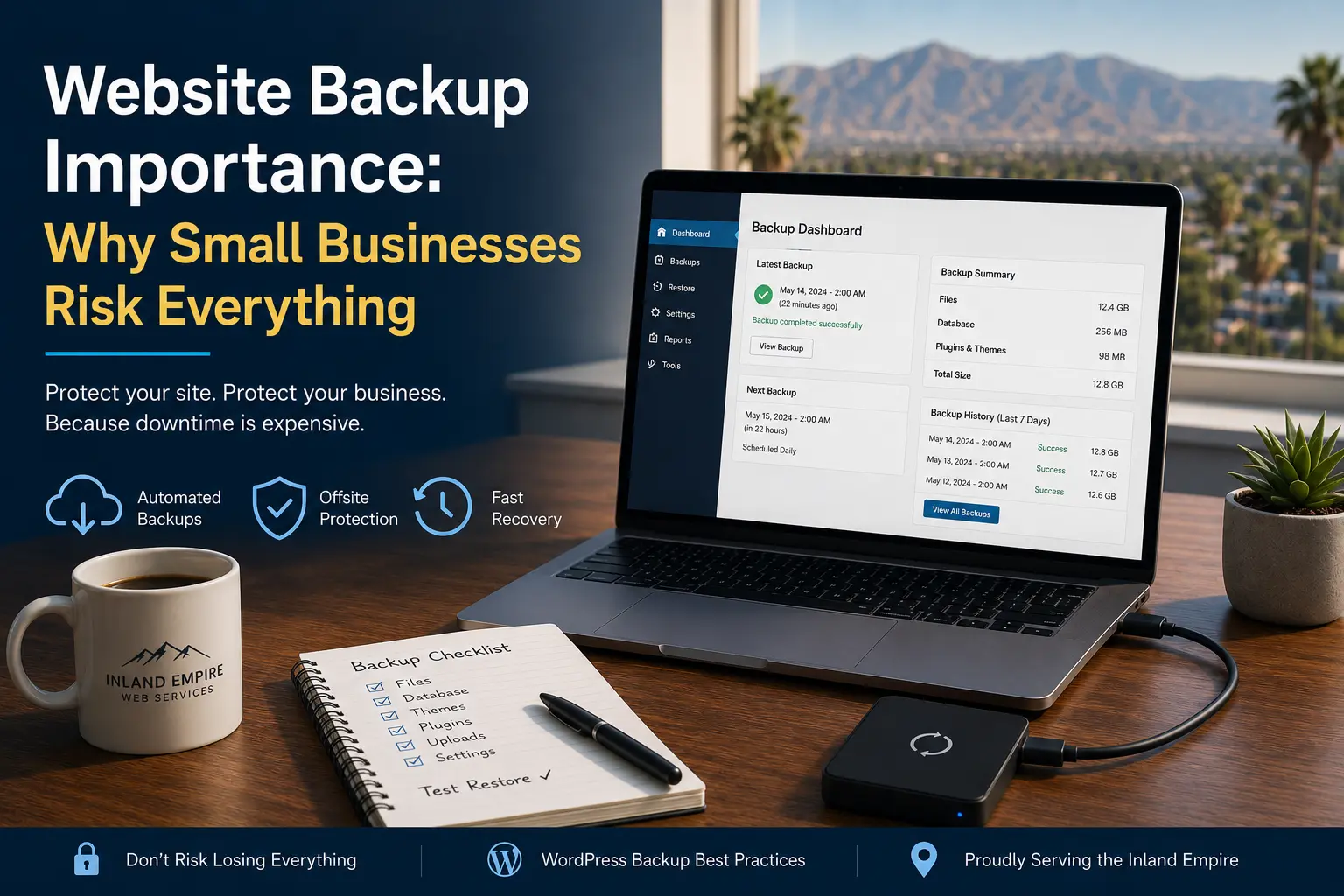
Most small business owners assume their web host automatically protects their website with reliable backups. In reality, hosting backups are often incomplete, stored on the same vulnerable infrastructure, can fail silently, and frequently prove useless when disaster strikes, leaving businesses facing weeks of downtime and thousands in recovery costs.
Key Points:
Real-world risk: A single server failure, hack, or human error (like Angela’s pet grooming site in Calimesa) can wipe out years of content, photos, reviews, and booking systems with no easy recovery.
Why hosting backups aren’t enough: Same-server storage, short retention periods, silent failures, incomplete data (files vs. database), and slow restores make them unreliable as a primary solution.
What a real backup system requires:
Automated daily (or more frequent) scheduling.
Off-site storage (e.g., Google Drive, Amazon S3).
Complete captures of both files and database.
Regular verification, monitoring, and tested restores.
Professional tools like UpdraftPlus, BackupBuddy, or managed services handle this reliably for a low monthly cost.
Bottom line: Your website is one crash, hack, or mistake away from disaster. Reliable, off-site, verified backups aren’t optional insurance, they’re essential business continuity for any Inland Empire small business relying on its online presence. Don’t wait for the crisis to learn the difference.
Your hosting company probably has a backup system. That is not the same thing as having a backup.
Here's why that distinction matters and what it cost one Inland Empire business owner to learn it.
Angela owns a pet grooming salon in Calimesa. She built her WordPress website herself over four years, a genuine labor of love. Two hundred and thirty blog posts. A full gallery of before-and-after photos her clients loved. An online booking system. A testimonials page with 60+ written reviews from loyal customers. Service pages she'd refined through dozens of revisions until they converted exactly the way she wanted.
On a Thursday afternoon in September, her hosting company experienced a server failure. Not a minor hiccup, a catastrophic storage system failure that corrupted data across multiple accounts.
Angela called her web developer immediately. "Don't worry," he said. "Your host backs everything up automatically."
Angela called the hosting company. A support representative walked her through what they found: her account's automated backup job had been silently failing for four months due to a storage limit that nobody had monitored. The last successful backup was 127 days old, and it was stored on the same server infrastructure that had just failed.
Her website, four years of content, photos, booking integrations, and testimonials, was gone.
The rebuild took six weeks. A professional developer. $2,400 in recovery and reconstruction costs. Roughly 180 blog posts she was able to partially reconstruct from Google cache before those expired too. The photos were gone. The testimonials existed only as screenshots she found in her phone's camera roll. The booking system had to be rebuilt from scratch.
Angela's business survived. But six weeks offline in September, the beginning of fall grooming season, cost her an estimated $8,000–$12,000 in lost appointments and new customer acquisition that went to competitors whose websites stayed up.
The most painful part of Angela's story: a verified, off-site backup system would have cost her $5–$15 per month. The backup plugin was free. The storage was the cost of a coffee.
This is not an unusual story. It's the most predictable preventable loss in small business technology, and across the Inland Empire, it's happening to businesses every month that made the same assumption Angela did: that "the host handles backups" means "I have backups."
It doesn't. Here's why, and what an actual backup system looks like.
The Assumption That Destroys Businesses: "My Host Backs Me Up"
Almost every small business owner who has experienced a catastrophic website loss tells a version of the same story. Somewhere in their mental model of how websites work, they believed their hosting company was protecting their data. Many hosting companies contribute to this belief with vague marketing language about "automatic backups" and "data protection."
Here is what most hosting company backup systems actually provide and what they don't.
What Hosting Company Backups Typically Are
What it includes: Most hosting providers run automated backup processes on their server infrastructure. These are designed primarily to protect the hosting company's systems in the event of hardware failure or data center issues. Many hosting plans include some version of client-accessible backups. Daily, weekly, or rolling snapshots that you can theoretically restore from through your hosting control panel.
Why it matters and why it's not enough: Hosting backups are infrastructure-level protection, not account-level protection. Several critical limitations apply:
Limitation 1: They're stored on the same infrastructure they're meant to protect. If your site and your backup live on the same server cluster, a server failure, the most common catastrophic event, can destroy both simultaneously. Angela's situation exactly.
Limitation 2: They can fail silently. Automated backup jobs can fail due to storage limits, permission errors, script timeouts, or configuration issues, and continue to fail for weeks or months without any alert being sent to the account owner. The backup dashboard still shows "backup enabled." The backups simply aren't running.
Limitation 3: They may not include your full site. Some hosting backup systems capture server-level snapshots that don't translate cleanly to WordPress file and database restores. Others capture only files, not the database, which means restoring the backup recovers the site's shell but not its content.
Limitation 4: Retention periods are often short. Many hosting backup systems retain 7–14 days of backups. If your site is hacked and the infection isn't discovered for three weeks, which is common, the clean pre-infection backup may no longer exist.
Limitation 5: Restore is often slower and less reliable than you'd expect. Restoring from a hosting-level backup is not always a simple click. It can require support tickets, manual processes, and significant time, measured in hours or days, not minutes.
None of this means hosting company backups are worthless. They're a useful secondary layer. The critical error is treating them as your primary, or only, backup strategy.
What an Actual Backup System Looks Like
A professional backup system has four non-negotiable characteristics: it's automated, it stores data off-site, it's regularly verified, and it's been tested with an actual restore.
Remove any one of those four characteristics and you have something that resembles a backup system without providing the protection a backup system is supposed to provide.
The Three Scenarios Where Backups Are the Difference Between Recovery and Rebuilding
Understanding why backups matter requires understanding what you're actually protecting against. There are three primary scenarios, and they're more common, and more unpredictable in timing, than most business owners realize.
Scenario 1: Security Breach and Hack Recovery
What it includes: A hacker gains access to your site through a plugin vulnerability, a brute-force login attack, a compromised admin password, or a hosting environment exploit. They install malware, inject spam links, redirect visitors to other sites, or, in the most damaging cases, delete or encrypt your site's files and database.
Why it matters: Security breaches are the most common reason small business websites require emergency recovery. When a site is hacked, the cleanup process requires:
Identifying the entry point
Removing all malicious code
Closing the vulnerability
Verifying the site is clean
In many cases, a thorough malware cleanup requires restoring from a known-clean backup, because malicious code can be embedded in dozens of files across the site, and manual removal is both time-consuming and imperfect. A professional-grade backup system with sufficient retention (30+ days) means you can restore to a clean state from before the infection, rather than attempting to surgically remove every trace of malware from a compromised site.
The backup retention problem: Hackers often deliberately time their visible damage weeks after the initial intrusion. They gain access quietly, plant backdoors, and wait before doing obvious damage. When the damage surfaces, the "clean" backup from before the infection may be outside a 7-day or 14-day retention window. This is why 30-day retention is the professional standard, not 7 days.
Scenario 2: Human Error and Accidental Deletion
What it includes: Someone, you, a team member, a developer, a well-intentioned contractor, accidentally deletes content, overwrites pages, breaks the theme during an edit, or applies an update that conflicts with the site's configuration in a way that's difficult to reverse.
Why it matters: Human error is the most frequent cause of website recovery events for small businesses. It's also the most psychologically difficult to anticipate, because it requires acknowledging that you or someone you trust might do something damaging by accident. Common scenarios:
A developer applies an update without a backup and a plugin conflict crashes the site
A business owner editing their own site accidentally deletes a page or overwrites content
A team member uploads images that replace existing files with similar names
A page builder update causes incompatibility that corrupts a page layout
A database optimization plugin runs with the wrong settings and removes data it shouldn't
None of these scenarios require a malicious actor. All of them require a clean, recent backup to resolve quickly and fully.
The "recent" requirement: Human error is why daily backups are more valuable than weekly backups. If you delete a key page on a Tuesday and don't notice until Friday, a daily backup gives you a Tuesday restore point. A weekly backup may give you a Sunday restore point, missing 2–3 days of content updates, new blog posts, or booking data.
Scenario 3: Hosting Failure and Infrastructure Collapse
What it includes: A hosting server experiences hardware failure, data corruption, a data center power event, a network failure, or, in rarer but real cases, a hosting company goes out of business or has a platform migration that corrupts customer data.
Why it matters: Angela's story. Hosting infrastructure failures are lower probability than security breaches or human error, but their consequences are the most severe when they occur, because the failure often affects both the site and the hosting company's own backups simultaneously.
Why off-site storage is non-negotiable: An off-site backup is one stored outside your hosting provider's infrastructure entirely, in Google Drive, Dropbox, Amazon S3, Backblaze, or another independent storage service. If your hosting provider experiences a catastrophic infrastructure event, your off-site backup is unaffected. It exists outside the failure zone.
Business owners who have off-site backups and experience a hosting failure recover in hours. Business owners whose backups lived on the same hosting infrastructure that failed, like Angela, are rebuilding from zero.
What a Professional Backup System Actually Requires
A properly configured backup system has five components. All five are necessary. Missing any one of them creates a gap that can surface at the worst possible moment.
Component 1: Automated Scheduling
What it includes: Backups that run on a defined schedule without requiring manual initiation. For most small business websites, daily automated backups are the standard. High-traffic sites, e-commerce sites with daily transactions, or sites with frequent content updates benefit from twice-daily backups. Static, infrequently updated sites can reasonably operate on weekly automated backups.
Why it matters: A backup system that requires you to remember to run it is not a backup system, it's a backup intention. The value of automated scheduling is that the backup runs regardless of how busy you are, what month it is, or whether you thought about your website at all. The human memory factor is removed from the equation.
The right tool: UpdraftPlus, BackupBuddy, Jetpack Backup, and BlogVault are the most commonly used WordPress backup plugins among professional web management providers. UpdraftPlus free tier is functional for basic needs; premium tiers add scheduling control, incremental backups, and additional storage integrations. BackupBuddy and BlogVault are favored for managed hosting environments with more complex restore requirements.
Component 2: Off-Site Storage
What it includes: Backup files stored in a location physically and logically separate from your hosting server. Google Drive, Dropbox, Amazon S3, Microsoft OneDrive, and dedicated backup storage services (Backblaze B2) are all valid off-site storage options.
Why it matters: The entire purpose of a backup is to have a clean copy of your site that survives whatever happens to the primary copy. If your backup lives on the same server as your site, it cannot survive a server failure, ransomware attack, or hosting account compromise. Off-site storage is the architectural requirement that makes a backup actually useful in a catastrophic scenario.
Storage cost: Off-site backup storage is not expensive. Google Drive provides 15GB free. Amazon S3 storage for a typical small business website backup (2–10GB) costs $0.02–$0.23 per month. Backblaze B2 charges similar rates. The cost of off-site storage is genuinely negligible relative to what it protects.
Component 3: Both Files and Database
What it includes: A complete backup captures two distinct components of a WordPress site:
WordPress files: All theme files, plugin files, uploaded images and media, and WordPress core files. Without these, your site has no code or visual assets.
WordPress database: All your content (pages, posts, comments), site settings, user accounts, plugin configurations, and metadata. Without the database, your site has code but no content.
Both are required for a complete restore. A backup that captures only files leaves your content behind. A backup that captures only the database leaves your theme and plugins behind. Backup plugins that capture both are essential, confirming that your backup solution explicitly includes both components. Verify by unzipping the download and review the included files. You will see a folder called public or public_html that contains all your files and a file database.sql, name may be something other than database.
Component 4: Verification and Monitoring
What it includes: Monthly confirmation that automated backups are completing successfully and that the backup files are valid. Checking the backup plugin dashboard for success/failure status. Reviewing backup file sizes for anomalies (a backup file that's suddenly much smaller than previous backups may indicate incomplete capture). Confirming off-site storage is receiving backup files.
Why it matters: Automated backup jobs fail silently. Storage limits fill up. Plugin conflicts disable backup processes. Scheduled tasks get disrupted by hosting environment changes. A backup system you've never verified is a backup system you can't trust.
Angela's backup system appeared to be working. The dashboard showed no errors. Nobody had verified that backups were actually completing and reaching off-site storage in four months. The verification gap was the failure.
Verification takes 5 minutes per month. It is the highest-return 5 minutes in your website maintenance schedule.
Component 5: Tested Restore Process
What it includes: At minimum quarterly, performing a full restore test to a staging environment, downloading your most recent backup file, spinning up a staging copy of your site, and confirming the restore produces a complete, functional website that matches your live site.
Why it matters: A backup file that has never been tested is a theoretical recovery plan. Backup files can be corrupted. Restore processes can fail. Backup configurations can capture incomplete data without triggering any error alert. The only way to know your backup works is to have used it.
The worst time to discover your backup doesn't restore cleanly is during a live recovery event, at 11 p.m. on a Sunday when your site is down and customers can't reach you. A quarterly restore test discovers this problem in a low-stakes environment where you have time to fix it.
Bonus Component: Retention Policy
What it includes: Maintaining multiple backup points, not just the most recent, across a meaningful retention window. The professional standard is 30 days of daily backups, giving you 30 restore points to choose from.
Why it matters: Not every recovery event requires the most recent backup. A hack that's been silently present for three weeks requires a restore to a point 25 days ago, not yesterday. A content deletion discovered two weeks after it happened requires a restore to a point 15 days ago. Retention policy is what makes those restore points available when you need them.
Hosting companies that provide "automatic backups" typically retain 7–14 days. Professional backup systems retain 30 days as a minimum standard.
The Real Cost of Not Having Backups
Most small business owners underestimate what website loss actually costs because they think about direct recovery costs and stop there. The full cost picture is significantly larger.
Direct Recovery Costs
Recovery Scenario | Average Cost Range |
|---|---|
Professional malware cleanup (no backup) | $300–$1,500 |
Partial site rebuild from archive/cache | $800–$3,000 |
Full site rebuild from scratch | $2,500–$15,000 |
Lost data reconstruction (content, images) | $500–$5,000 |
Emergency developer time (nights/weekends) | $150–$300/hour |
Indirect and Revenue Costs
Revenue Impact | Cost Range |
|---|---|
Downtime during rebuild (per week) | $1,000–$10,000+ depending on traffic |
Google ranking recovery (post-hack/outage) | 2–6 months, $2,000–$8,000 in lost organic traffic value |
Customer trust damage | Unquantifiable but real |
Competitor gains during downtime | Permanent for some customers |
Emergency communication and customer notifications | Staff time + reputation cost |
The Comparison That Ends the Conversation
Prevention | Annual Cost |
|---|---|
UpdraftPlus Premium | $70–$140/year |
Off-site storage (Google Drive or S3) | $0–$30/year |
Professional managed backup in Web CARE plan | Included in plan |
Total prevention cost | $0–$170/year |
Recovery (no backup) | Average Cost |
|---|---|
Basic hack with partial recovery | $800–$3,000 |
Major breach requiring rebuild | $5,000–$20,000 |
Server failure, full rebuild | $3,000–$15,000 |
Total unprotected risk | $800–$20,000+ |
There is no scenario in which skipping backup investment is financially rational for a business that depends on its website.
The 5 Backup Configurations That Fail When You Need Them Most
These are the backup setups that look like they're working until the moment they're actually needed, and then don't deliver.
❌ Failure Configuration 1: Hosting-Only Backups with No Off-Site Copy
What it looks like: You've confirmed your host has a backup feature enabled. You've never set up a separate backup plugin. You've never verified that backups are being stored anywhere except your hosting account.
Why it fails: Server failure, ransomware, or hosting account compromise takes both the site and the backup simultaneously. This is the most common configuration we find when doing new client onboarding audits.
❌ Failure Configuration 2: Backup Plugin Installed but Never Configured
What it looks like: UpdraftPlus or a similar plugin is installed. It's active. The settings were never completed, no storage destination configured, no schedule set, no remote storage connected. The plugin exists but isn't running.
Why it fails: Installation is not configuration. An unconfigured backup plugin creates no backups. Many business owners see the plugin in their dashboard and assume it's working.
❌ Failure Configuration 3: Backups Running but Unverified for Months
What it looks like: Backups appear to be scheduled. You haven't logged into the backup dashboard in months. Storage limits may have been reached, plugin conflicts may have disrupted the process, or the scheduled task may have been disabled by a WordPress update. Nobody is checking.
Why it fails: This is Angela's exact configuration. Backups that run without verification are theoretical until the moment you need them, at which point they may reveal months of silent failure.
❌ Failure Configuration 4: Files Backed Up, Database Not Included
What it looks like: A backup solution that captures only WordPress files, theme, plugins, uploads, but not the database. This is a misconfiguration in some backup plugins when set up incorrectly.
Why it fails: Without the database, you have an empty site structure. All content, pages, posts, settings, user accounts, plugin configurations, lives in the database. A files-only backup cannot produce a working website on restore.
❌ Failure Configuration 5: Backups Never Tested
What it looks like: A backup system that appears to be running correctly, has verified completion logs, stores files off-site, but has never been used to perform an actual restore.
Why it fails: Backup files can be corrupted. Restore processes can have incompatibility issues with the current hosting environment. Incomplete captures can pass completion checks while missing critical data. A backup that has never been restored is an untested hypothesis.
Does Your Website Have Real Backup Protection? Self-Assessment
Answer honestly, this assessment is only useful if the answers are accurate:
Question | Yes | No | Not Sure |
|---|---|---|---|
I have an automated backup plugin installed and configured | ⬜ | ⬜ | ⬜ |
Backups run on a defined automated schedule (daily or weekly) | ⬜ | ⬜ | ⬜ |
Backup files are stored off-site (not on my hosting server) | ⬜ | ⬜ | ⬜ |
My backup captures both WordPress files AND the database | ⬜ | ⬜ | ⬜ |
I have verified backups completed successfully in the last 30 days | ⬜ | ⬜ | ⬜ |
I retain at least 14 days of backup history (30 days preferred) | ⬜ | ⬜ | ⬜ |
I have performed a restore test in the last 6 months | ⬜ | ⬜ | ⬜ |
A full backup is taken before every update session | ⬜ | ⬜ | ⬜ |
I know where my backup files are stored right now | ⬜ | ⬜ | ⬜ |
I could recover my site within 2 hours if it disappeared today | ⬜ | ⬜ | ⬜ |
8–10 Yes: Your backup system is genuinely protecting your site. Maintain the restore testing discipline.
5–7 Yes: Meaningful gaps exist. The "No" and "Not Sure" answers represent real vulnerability.
3–4 Yes: Your backup protection is partial at best. The risk of unrecoverable loss is significant.
0–2 Yes: You do not have a functioning backup system. This is the highest-priority item on your website maintenance list, above content, above SEO, above everything else.
How to Set Up a Proper Backup System Today
If you're managing your own site and want to implement proper backup protection, here's the setup process:
Step 1: Install and Configure UpdraftPlus (Free)
UpdraftPlus is the most widely used WordPress backup plugin with over 3 million active installations. The free version is sufficient for basic needs.
Configuration:
Files backup schedule: Weekly (daily if your site updates frequently)
Database backup schedule: Daily
Retain this many scheduled backups: 4 (gives you 4 weeks of history on weekly schedule)
Remote storage: Connect Google Drive, Dropbox, or Amazon S3
Critical: Don't just install it. Complete the remote storage configuration. Run a manual backup immediately after configuration. Verify the backup files appear in your chosen remote storage location.
Step 2: Configure Off-Site Storage
Google Drive is the simplest option for most small business owners, it's free up to 15GB, connects directly in UpdraftPlus settings, and doesn't require creating a new account.
Setup:
In UpdraftPlus settings, select "Google Drive" as your remote storage
Authenticate with your Google account
UpdraftPlus creates a dedicated backup folder in your Drive
Run a manual backup and verify the files appear in that folder
Amazon S3 and Backblaze B2 are better choices for sites with large backup files (high-resolution photo galleries, large media libraries) where the 15GB Google Drive free tier may be insufficient.
Step 3: Run Your First Manual Backup and Verify
After configuration, click "Backup Now" in the UpdraftPlus dashboard with both "Include your database in the backup" and "Include your files in the backup" selected. Monitor the backup progress. After completion:
Check the UpdraftPlus dashboard, does it show a successful completion with a timestamp?
Log into your off-site storage, do the backup files appear in the designated folder?
Note the backup file sizes, are they in a reasonable range for your site's content volume?
If both confirm, you have your first verified backup. Schedule a calendar reminder to verify this monthly.
Step 4: Document Your Restore Process Before You Need It
Write down (or save in a secure note):
Where your backup files are stored (storage provider and folder path)
Which backup plugin you're using and its version
How to access your hosting control panel to upload restored files
Your hosting database access credentials (phpMyAdmin or similar)
You don't want to be researching restore procedures at 11 p.m. during a live site failure. Document the process now, while everything is working.
Step 5: Test a Restore Within 30 Days
Within a month of setting up your backup system, perform a restore test on a staging environment. Most quality hosting providers include a one-click staging site feature. If yours doesn't, a free staging environment can be created through InstaWP or a local development tool like LocalWP.
The test: restore your most recent backup to the staging environment. Does the site load? Does all your content appear? Are your plugins active and configured correctly?
If the answer to all three is yes, you have a verified, tested backup system. Repeat this test quarterly.
Frequently Asked Questions
What's the difference between a WordPress backup and a hosting backup? A WordPress backup is a dedicated plugin-level backup that captures your WordPress files and database separately, stores them in a location you specify (including off-site), and runs on a schedule you control. A hosting backup is an infrastructure-level process run by your hosting company, typically designed to protect their systems, stored on their own infrastructure, subject to their retention policies, and not individually verified per account. Both have value; neither is a substitute for the other. A proper backup strategy includes both, with your own plugin-based, off-site backup as the primary recovery resource.
How much storage do I need for website backups? Most small business WordPress websites produce backup files ranging from 500MB to 5GB depending on media library size. A site with hundreds of high-resolution photos will produce larger backups than a text-focused site. With 30-day retention at daily backups, you're looking at 15–150GB of total storage depending on site size. Google Drive (15GB free), Amazon S3, and Backblaze B2 are all cost-effective options. For most IE small businesses without large media libraries, Google Drive free tier covers backup storage adequately.
How long does it actually take to restore a website from backup? With a properly configured backup system and a tested restore process, a complete site restore typically takes 30–90 minutes for a standard small business WordPress site. The restore time involves downloading the backup files, uploading them to the new hosting environment, importing the database, and verifying the site loads correctly. Emergency professional restores can be completed in under an hour by an experienced developer. Without a backup, rebuilding a similar site from scratch takes weeks and costs thousands of dollars.
Is my website backup safe from ransomware if it's stored in Google Drive? Generally yes, with an important nuance. Google Drive backups stored independently from your site are not accessible via your hosting server or WordPress installation, so a ransomware attack on your hosting environment typically cannot reach your Drive backups. However, if your Google account credentials are compromised and an attacker gains access to your Google Drive, backups stored there could be affected. Best practice: use a dedicated Google account for backup storage rather than your primary business Google account, and enable two-factor authentication on that account.
What should I do right now if I'm not sure whether my backups are working? Log into your WordPress dashboard and check for a backup plugin. If one is installed, open its settings and check when the last backup completed, and verify that backup files exist in your configured remote storage. If no backup plugin is installed, or if the last verified backup is more than 30 days old, install and configure UpdraftPlus with Google Drive storage and run a manual backup today. Do not postpone this, the cost of 30 minutes of setup is incalculable compared to the cost of recovery without a backup.
Can I rely on my web management company to handle backups, or should I maintain my own? A professional web management service should include automated backup management as a core deliverable, not a separate add-on. This means daily or weekly backups with off-site storage, monthly verification, and quarterly restore testing, all documented in your monthly report. If your current provider doesn't include backup management with verification in their service, that's a gap worth addressing. Maintaining your own backup system in addition to your management provider's backups is a belt-and-suspenders approach that's never wrong for business-critical sites.
IE Web Services Web CARE Plans: Backup Protection That Actually Works
After 20+ years serving Inland Empire businesses, we've seen what recoverable looks like and what unrecoverable looks like. The difference is almost always a properly configured, verified, off-site backup.
Our Web CARE plans treat backup management as a foundational service, not an afterthought:
✅ Full site backup before every update session: files and database, every time, without exception
✅ Automated scheduled backups: daily or weekly depending on your plan and site activity
✅ Off-site storage: backup files stored outside your hosting infrastructure
✅ Monthly backup verification: we confirm backups are completing and files are valid, every month
✅ Quarterly restore testing: we verify your backup actually produces a working site
✅ 30-day retention: 30 restore points available, not just the most recent backup
✅ Critical security patches within 24 hours: reducing the scenarios where emergency recovery is needed
✅ Weekly security scanning: catching threats before they require backup restoration
✅ Uptime monitoring: 24/7 alerts so outages are caught before they become extended events
✅ Monthly written report: backup status documented every month, verified and delivered
We also connect website management to local SEO, data analytics, and full-service digital marketing for businesses ready to grow beyond protection into active market expansion.
Get Your Free Backup and Security Assessment
Not sure whether your current backup system would actually protect you in a real crisis? Our free assessment tells you exactly where your backup protection stands and what gaps exist before they become a problem.
We review:
Whether an active backup plugin is installed and correctly configured
Whether backup files are being stored off-site, outside your hosting server
Whether both WordPress files and database are included in your backups
When the last successful backup completed and whether the files are verifiable
Whether your backup retention window covers 30 days of restore points
Whether you have a tested restore process on record
Your security posture, vulnerability scan, plugin versions, WordPress core status
You'll receive a specific, honest report on your backup and security status, with clear guidance on what needs to change. No obligation, no sales pressure.
Schedule Your Free Backup Assessment →
Angela rebuilt. Six weeks, $2,400, and a lot of late nights reconstructing what she could. Her new site has daily automated backups, Google Drive off-site storage, and monthly verification built into her management plan. She tested the restore in January, it worked in 40 minutes. That test is now the most important thing she's done for her business technology in four years.
The backup you set up today is the one that saves you later. Not the one you plan to set up.
IE Web Services proudly serves businesses throughout the Inland Empire, including Riverside, San Bernardino, Corona, Ontario, Rancho Cucamonga, Fontana, Moreno Valley, Temecula, Murrieta, Redlands, Beaumont, Banning, Calimesa, Hemet, Perris, Menifee, Lake Elsinore, Eastvale, Jurupa Valley, Norco, Chino, Chino Hills, Upland, and surrounding communities.
Sources: WordPress.org — Backing Up Your Database | Wordfence — WordPress Backup Best Practices | Google Drive Storage Plans | Verizon Data Breach Investigations Report | WPScan WordPress Vulnerability Database