
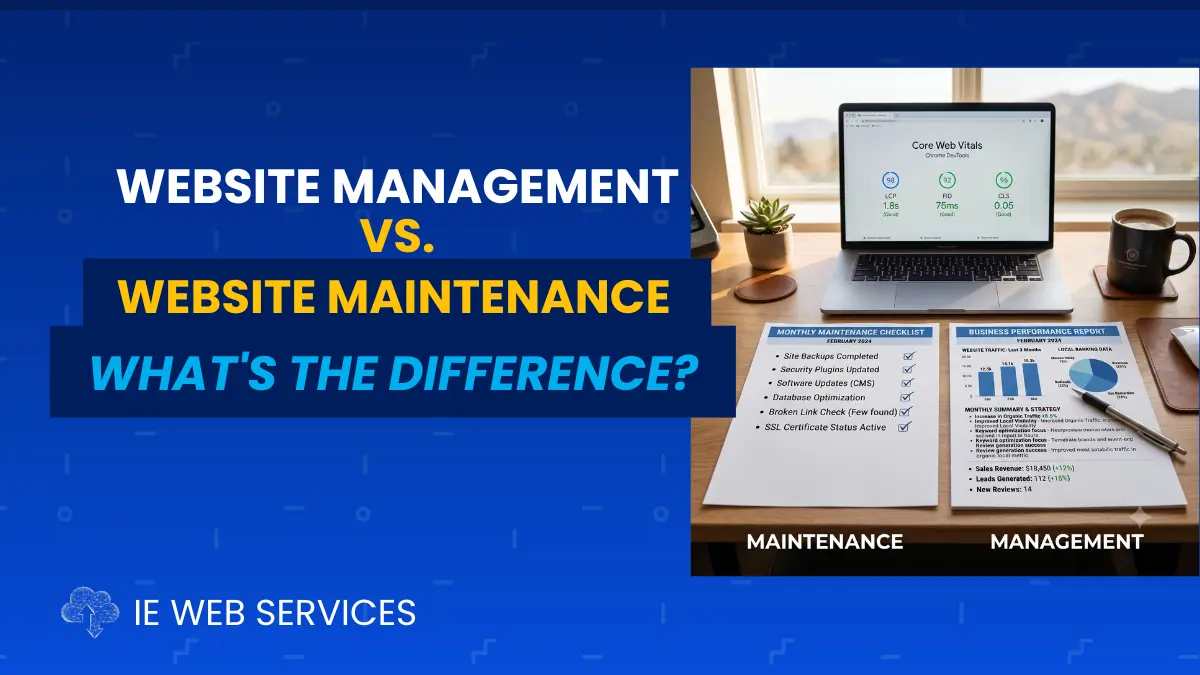
The two terms get used interchangeably all the time. They shouldn't be.
One keeps your website from breaking. The other makes sure it's actually working for your business.
David owns an HVAC company in Banning. A few years ago, he signed up for what his hosting company called a "maintenance plan," priced at $15 a month, added almost as an afterthought during checkout. He assumed that covered him. Updates would happen, backups would run, and he could stop thinking about the technical side of his website entirely.
What he actually got was exactly what the name promised and nothing more: WordPress core updates applied automatically, on a schedule he had no visibility into, with no reporting, no performance monitoring, and no attention paid to whether his site was actually generating leads. When his Google rankings for "HVAC repair Banning" quietly slipped over eighteen months, nothing in his maintenance plan was designed to catch it, because catching it was never part of what he'd paid for.
David wasn't wrong to think he needed something. He was wrong about what that something needed to be. He had purchased maintenance. What his business actually needed was management. The difference between those two words ended up costing him a meaningful chunk of his organic search visibility before anyone flagged the gap.
This confusion is extremely common among business owners across Beaumont, Banning, Calimesa, Yucaipa, and Redlands, largely because the industry itself uses "maintenance" and "management" loosely, sometimes interchangeably, sometimes to describe very different scopes of work depending on the provider. Here's the actual distinction, and why it matters for your business.
Website Maintenance: Keeping the Lights On
Website maintenance refers to the technical upkeep required to keep a website functioning and secure. It's foundational, necessary, and genuinely important, but it's also narrower in scope than most business owners assume.
What it includes: Applying WordPress core, plugin, and theme updates. Running scheduled backups. Monitoring for security vulnerabilities and applying patches. Keeping the site online and functioning without errors.
Why it matters: Without maintenance, a website degrades. Security vulnerabilities accumulate, software falls out of date, and the site becomes progressively more fragile and more exposed. Maintenance is the baseline that prevents a website from actively breaking or being compromised.
What maintenance does not typically include: Performance optimization tied to business outcomes, local SEO activity, content strategy, conversion tracking, competitive positioning, or a monthly report connecting technical work to actual business results. A maintenance plan keeps the site running. It doesn't ask whether the site is running well, or whether it's actually producing leads.
This is the gap David fell into. His plan was doing real, legitimate work. It just wasn't the work that would have caught a slow decline in search rankings, because that kind of monitoring isn't what maintenance, in the narrow sense, is designed to do.
Website Management: Keeping the Website Working for the Business
Website management is the broader discipline. It includes everything maintenance covers, but adds the layer of active oversight, performance tracking, and strategic attention that connects the technical health of a website to actual business outcomes.
What it includes: Everything under maintenance (updates, backups, security), plus Core Web Vitals monitoring and performance benchmarking, Google Business Profile management, local SEO activity, content freshness reviews, analytics review and reporting, and a monthly written report that shows exactly what was done and why it matters for your business specifically.
Why it matters: Management is what catches the problem maintenance alone would miss. A management provider watching Core Web Vitals scores month over month would have caught David's declining performance early. A management provider actively reviewing local search rankings would have flagged the slow slide in his "HVAC repair Banning" position long before eighteen months had passed.
The key distinction in one sentence: Maintenance keeps a website from breaking. Management makes sure a website is actually doing its job.
A Side-by-Side Comparison
Task | Maintenance | Management |
|---|---|---|
WordPress core, plugin, and theme updates | Included | Included |
Automated backups | Included | Included |
Basic security scanning | Included | Included |
Uptime monitoring | Sometimes | Included |
Core Web Vitals and performance benchmarking | Rarely | Included |
Google Business Profile management | Rarely | Included |
Local SEO activity and keyword tracking | Rarely | Included |
Content freshness review | Rarely | Included |
Monthly written report tied to business outcomes | Rarely | Included |
Named account contact | Sometimes | Included |
Strategic recommendations | Rarely | Included |
If your current plan only checks the boxes on the left, you have maintenance. If it also checks the boxes on the right, you have management. Neither is wrong to have, but they solve different problems, and pricing them the same way (or expecting management-level results from a maintenance-level plan) is where the confusion, and the cost, sets in.
Why This Distinction Matters More Than It Sounds
Because the two are frequently priced and marketed the same way. Providers use "website maintenance package" and "website management plan" almost interchangeably in marketing copy, even when the actual scope of work differs significantly. Business owners are often left to figure out the real scope only after signing up, sometimes only after something goes wrong.
Because maintenance-only plans create a false sense of security. A business owner paying for "maintenance" reasonably assumes their website is being taken care of in a comprehensive sense. In reality, they may only be protected against the narrowest category of risk (security and updates) while remaining fully exposed to the broader risks of declining performance, stagnant local SEO, and undetected ranking loss.
Because the businesses that benefit most from management are the ones relying on their website for real lead generation. A simple, low-stakes informational site might genuinely only need maintenance. A business like David's, generating leads through local search, needs the fuller scope of management to catch and correct problems before they cost real revenue.
Self-Assessment: Do You Have Maintenance or Management?
Question | Yes | No |
|---|---|---|
I receive a monthly written report connecting website activity to business results | ⬜ | ⬜ |
Someone actively tracks my Google rankings for my key services | ⬜ | ⬜ |
My Google Business Profile is actively managed as part of my plan | ⬜ | ⬜ |
My Core Web Vitals scores are checked and reported on regularly | ⬜ | ⬜ |
I have a named contact who understands my specific business goals | ⬜ | ⬜ |
My provider has ever proactively flagged a performance or ranking issue before I noticed it myself | ⬜ | ⬜ |
5 to 6 Yes: You have genuine website management.
2 to 4 Yes: You likely have maintenance with some management-adjacent elements, worth clarifying with your provider.
0 to 1 Yes: You almost certainly have maintenance only. That may be sufficient for a very simple site, but it leaves real gaps for a business depending on its website for leads.
Frequently Asked Questions
Is website management more expensive than website maintenance? Not always significantly. Because the terms are used inconsistently across the industry, price alone isn't a reliable indicator of scope. The way to know what you're actually paying for is to ask specifically whether Core Web Vitals monitoring, local SEO activity, and monthly reporting are included, rather than relying on whichever term appears in the plan's name.
Can a simple website get by with maintenance only? Yes, in some cases. A low-traffic, informational site with no lead generation function and minimal reliance on local search may not need the fuller scope of management. Any business relying on its website for actual leads, bookings, or sales generally benefits from the broader oversight management provides.
How do I find out which one I currently have? Ask your current provider directly whether Core Web Vitals are monitored monthly, whether your Google Business Profile is actively managed, and whether you receive a written monthly report. If the answer to those questions is generally no, you likely have maintenance rather than management, regardless of what the plan is called.
Does IE Web Services offer maintenance-only plans, or only full management? Our Web CARE plans are built around the fuller management scope described in this article, since we've found that partial maintenance-only coverage tends to leave the exact gaps that end up costing our clients the most, as it did for David. We're happy to talk through your specific situation to determine what level of service actually makes sense for your business.
What's the first sign that a maintenance-only plan isn't enough for my business? A gradual, hard-to-explain decline in leads or organic traffic is the most common signal, since maintenance-only plans typically have no mechanism to catch this kind of slow slide. If you're noticing fewer calls or form submissions without an obvious cause, it's worth checking whether your current plan is actually monitoring performance and rankings at all.
IE Web Services: Website Management Built for Real Business Results
Our Web CARE plans are built as full management, not maintenance with a different name on it. Every client throughout Beaumont, Banning, Calimesa, Yucaipa, and Redlands receives:
All standard maintenance: backup-first updates, security scanning, uptime monitoring
Monthly Core Web Vitals and performance benchmarking
Active Google Business Profile management
Local SEO tracking tied to your specific service area
A monthly written report connecting the work to your actual business results
A named contact who understands your goals, not a ticket queue
Get Your Free Website Assessment
Not sure whether your current plan is maintenance or management? We'll review what you're currently receiving, compare it against what your business actually needs, and give you a clear, honest answer.
Schedule Your Free Assessment →
David switched to full management six weeks after discovering the gap. His Core Web Vitals scores are now checked monthly, his Google Business Profile is active for the first time in years, and his rankings for "HVAC repair Banning" have started climbing back. The site itself barely changed. What changed was someone actually watching it.
IE Web Services proudly serves businesses throughout Beaumont, Banning, Calimesa, Yucaipa, Redlands, and surrounding Inland Empire communities.
Sources: Google Search Central, Core Web Vitals | Google Business Profile Help Center | Wordfence WordPress Security Intelligence | Google Search Console Help Center